
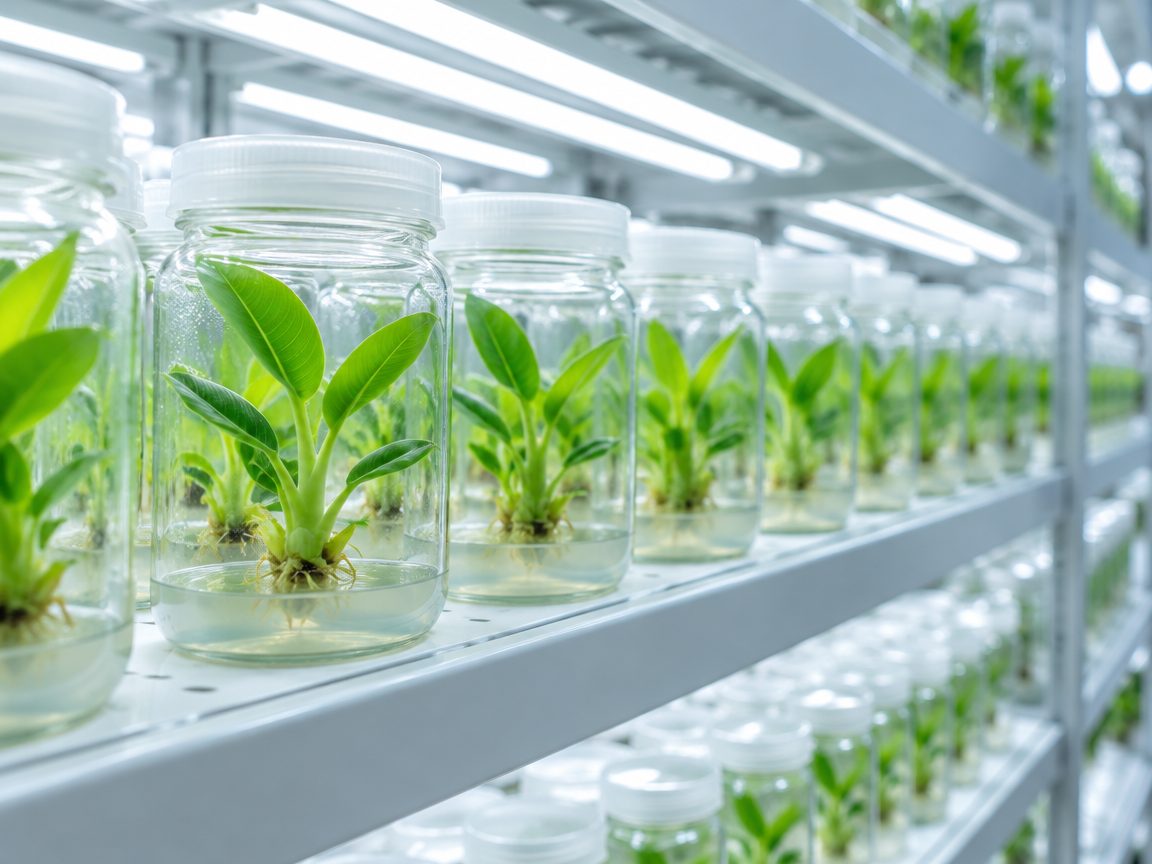
Plant tissue culture
Plants grown from tissue, not from chance
Our commercial tissue culture wing produces up to 1.75 crore plants a year — uniform, disease-free planting material for nurseries and growers across Central India.
The method
What tissue culture actually changes
In conventional propagation a plant is multiplied from suckers, cuttings or seed — and carries forward whatever disease, pest or variation the parent already had. Tissue culture takes a small piece of clean growing tissue, places it in a sterile nutrient medium, and multiplies the plant in a controlled environment.
The result is a plant that is genetically identical to a chosen mother line, free of the pathogens that accumulate in field-propagated material, and available in the quantity you need when you need it.
For a banana grower this is the difference between an orchard that ripens in one window and one that dribbles out over months.
Production capacity
1.75 crore
plants per year from our commercial wing
Flagship crop
Banana — Grand Naine
Our banana programme is the largest part of the wing. Other fruit and plantation crops are taken up on request, subject to mother material availability.
Why growers choose it
Four advantages you can see in the field
Disease-free planting material
Starting from clean meristem tissue removes the viruses and wilts that spread through suckers generation after generation.
Uniform, true-to-type plants
Every plantlet comes from a selected mother line, so the orchard grows evenly and matures together.
Year-round availability
Production does not wait for a season. You can plant to a market plan rather than to nursery stock.
Faster establishment
Hardened plantlets leave the laboratory ready for the field, with a root system that takes hold quickly.
In the laboratory
From mother plant to hardened plantlet
- 01
Mother plant selection
Healthy, high-performing mother lines are indexed and maintained in sterile conditions.
- 02
Shoot multiplication
Tissue is cultured on nutrient media in jars and flasks inside the sterile transfer room.
- 03
Rooting
Shoots develop roots in the rooting medium under controlled light and temperature.
- 04
Hardening
Plantlets move to the nursery for gradual acclimatisation to field conditions before dispatch.
Next step
Send us your soil. We will send back a plan.
Tell us your village, your crop and last season's yield. Our team will guide you on sample collection and what to test before your next sowing.