
01
Talk to us first
Tell us your village, the area you farm, the crop you plan and the last crop grown. We tell you which tests are worth doing and what they cost — before you spend a day collecting samples.
A five-minute call usually settles it.

From field to report
Soil testing is only useful if the sample represents the field and the report reaches you in time to act. Here is the whole route, step by step.
Tell us your village, the area you farm, the crop you plan and the last crop grown. We tell you which tests are worth doing and what they cost — before you spend a day collecting samples.
A five-minute call usually settles it.
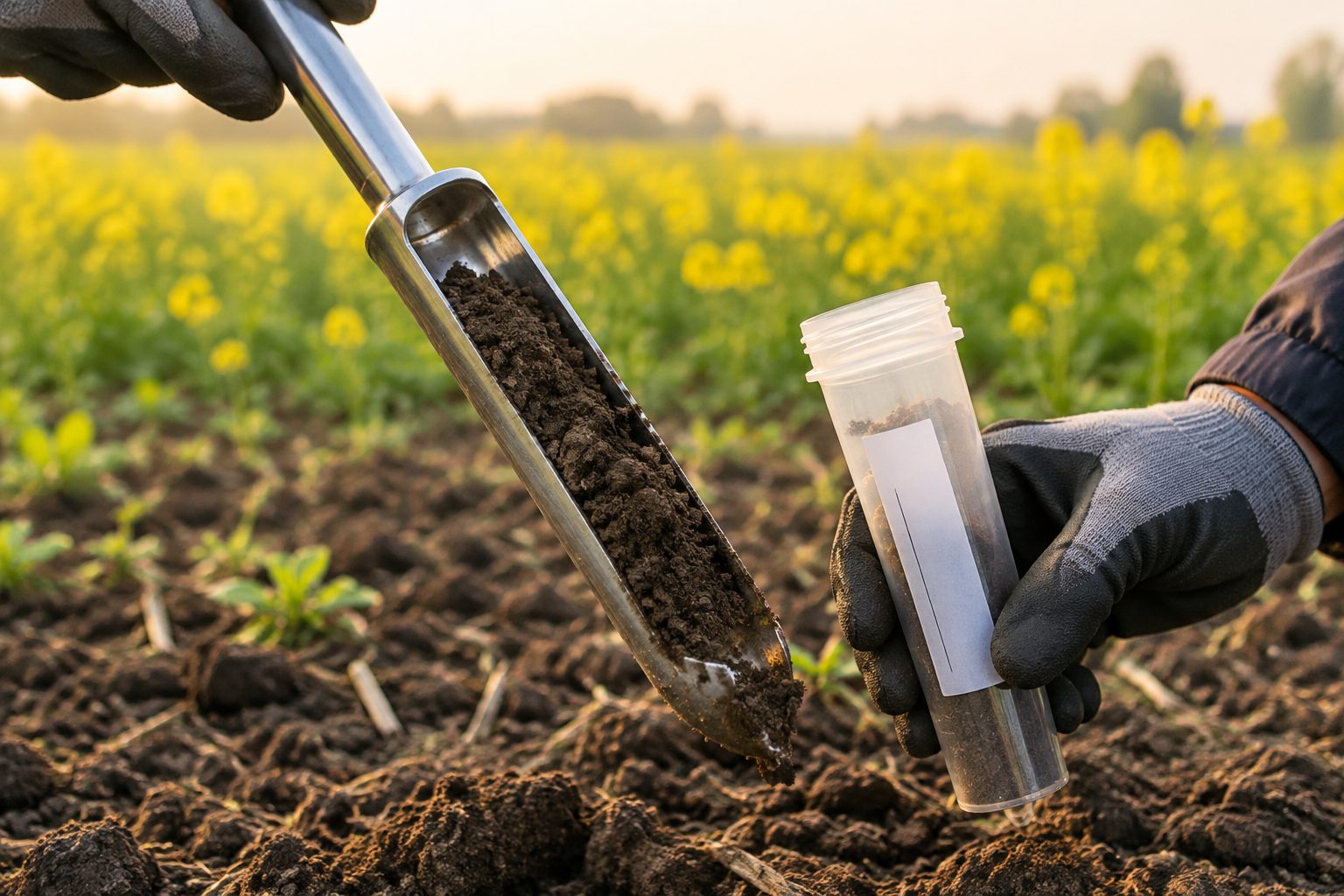
Take a composite sample from six to eight spots, air-dry it in shade and bring it in, or send it by courier. A label with your name, village, crop and mobile number is enough.
About 500 g of air-dried soil per field.
The sample is dried, ground and sieved, then analysed for reaction, salinity, organic carbon, macro and micronutrients using standard procedures. Every batch is checked before values are released.
Fifteen parameters across six groups.
You receive the measured values with a recommendation letter for your crop — which fertilizer, what quantity, when to apply, and what to correct first. Ask us to walk you through it on the phone.
We confirm the timeline when the sample is booked in.
Packing a sample
Send to
Tirupati Soil Testing Laboratory
Kag Market, In Front of SBI, Maheshwar Road, Barwaha
Distt. Khargone, Madhya Pradesh 451115
+91 94794 57733+91 94794 57787
Inside the laboratory
Samples are logged in with a unique number so your report can always be traced back.
Drying, grinding and sieving are done separately for each sample to prevent contamination.
Extractions and readings follow standard soil testing procedures, with reference samples run alongside.
Values are interpreted against your soil texture and the crop you intend — not against a single national average.
Reports are issued as soon as the analysis is complete. For a field that is about to be prepared, tell us your sowing date when you book the sample and we will confirm whether the timeline works.
Next step
Tell us your village, your crop and last season's yield. Our team will guide you on sample collection and what to test before your next sowing.